- You have to give me at least some bare specifics, or I won't know what to pray about. I will not pray for your unspoken requests, because they might be sinful. (But don't give me too much information...I do NOT want to hear it!)
- There must be something wrong with either your ability to form healthy relationships, or something wrong with your church's ability to provide such relationships, if you do not have someone you can trust with the details. You need to work out those problems with yourself or your church, instead of bringing your unspoken requests to us.
- If you're in a tragic situation where you don't have anyone that you can trust with the specifics, then why bother bringing your unspoken request to us? You obviously don't trust us, or you'd tell us more (but remember, not TOO much. We really don't want to hear it).
- You lack faith if you believe that your own prayers for yourself are inadequate. Trust God to listen to you as you pray for yourself. You don't need our prayers.
- I suspect that your request has something to do with your sinfulness, and your unwillingness to talk about it comes from your prideful unwillingness to confess your sin.
Wednesday, August 17, 2011
Why Should I Pray For You?
Friday, August 12, 2011
How I Mock Jesus (And You Do, Too)
Imagine, if you will, a classic tragic tale. (And if you think from the beginning that you know where it's going, hang in there. It might surprise you.)
Ours is the story of a prince (the best, most noble sort of prince) who dearly loves a peasant woman, though she seems incapable of returning his devotion. One day he hears that his beloved is sick, near death in fact, and that nothing can save her but a transfusion of his rare blood type. And her condition, he's told, is so desperate that it will take every drop of blood he has to save her. He will have to die.
Because of his love for her, he donates all of that blood. But as the last light of life is fading from his eyes, his beloved walks into the room. She takes in the scene, is told why the prince is dying, and responds condescendingly.
"Well, that was so very noble of you," she says with a pat on his arm. "I will do my best to remember your sacrifice, and I'll sing songs of praise to your memory every Sunday. But it was really a waste, you see. Noble, but unnecessary. You completely overreacted...my disease really wasn't that serious."
To her dying day, though she cherished sentimental thoughts of him, she remained mostly puzzled by the foolishness that had driven him to such extremes over nothing at all. She couldn't quite bring herself to honor his memory as she should, because she found his foolishness pitiable, and just a tad embarrassing.
I've been that peasant. Far more often than I care to admit. And I'm willing to bet that you have, too. Think not? Hear me out.
This morning I was in the mood to coddle one of my pet sins. And so I coddled away, not caring that I was doing so. It really wasn't a big deal.
My condition wasn't that serious.
Then I found myself in a conversation with one of my sons... a son who was once again revealing his love of "sin for sin's sake." He really loves badness because it's bad, and bad is fun.
As He so often does, my Prince of Peace convicted me by what came out of my own mouth. Here's the gist of what I heard myself saying:
Saturday, April 23, 2011
Just for Worship
Yesterday (Good Friday, 2011), I was privileged to use ASL in a dramatic presentation of "Watch the Lamb." Vocalist/pianist (and music minister) Bruce Webb, and violinist Bill Johnson accompanied my signing.
I hope you'll take a few minutes just to click on this link to a video of the presentation, and join me in worship. We will go back 2000 years and join Simon of Cyrene (Matt 27:32) as he encounters Christ on the road to Golgotha and ends up carrying His cross...and trying to help his children sort through what they've just witnessed.
Monday, April 4, 2011
Should We Really Want to Return to Mayberry?

I read a hopeful-sounding article today. It was called, "RIP: Girls Gone Wild?" I appreciated the news it shared; namely, that there are signs that Hollywood may be toning back on the level of filth it chooses to spew.
I celebrate the idea of a "cleaner Hollywood"...but with caution.
It is 100% good that Hollywood might clean up its act. The raunch and filth are a disgrace to our nation, and lend tragedy to the fact that we are still thought of (in some circles) as a "Christian" nation.
But oh, how deceptive sin is! And one of its favorite deceptions is called, "Playing dead" (link leads off-site). It doesn't mind lying low for a while, as long as its apparent absence lulls people into a false sense of security.
I cannot help noting how the debauchery of the '70's and its "Sexual Revolution" came out of the womb of the 50's and 60's, when TV was so good and clean, and not even Rob and Laura Petrie (The Dick Van Dyke Show) slept in the same bed. The adults watching the younger generation throwing virtue to the wind often asked themselves and others, "Where did we go wrong?"
I love the Dick Van Dyke Show, and other good clean oldies. They are a symptom, not a cause. Humanism began its takeover long before most homes even had televisions. I don't blame these shows for what happened. I enjoy watching them with my kids sometimes. But I see how Satan took a fairly benign thing and twisted it for evil, as he so loves to do.
You see, there was a loud, unspoken message in the good, moral oldies, a message that not only reflected its era, but reinforced that era's values.
We are fine without God...or at least with only the occasional tip of the hat to him.
The Petries didn't center their lives around Him, and they were good people. Same for the Ozzie and Harriet Nelsons, the Ward and June Cleavers, Andy Taylor and little Opie, and all the rest. They were all so very likeable, so very clean, certainly not sinners in desperate need of a Savior. Few viewers minded the relative absence of a holy God in their favorite characters' good lives.
Being "good people" was enough. Our TV favorites may have ignored God for the most part, but they certainly wouldn't have cursed Him. They were safely neutral, and we could safely amuse ourselves as we immersed ourselves in their neutrality. Except, of course, that we forgot the words of the Holy One:
Whoever is not with me is against me,
and whoever does not gather with me scatters. (Matt. 12:30)
The church fell asleep on the job, smugly satisfied with the moral superiority of our modern American people. God was declared to be a figure of total benignity, without wrath for sin. The basic goodness of mankind, as preached from the grave by Ann Frank, on the screen by the best of TV, from the vaunted halls of the UN, and from countless other sources helped push God to the back burner even in the mainline denominations.
Again, the good old shows are merely symptoms, not root causes, though they did have strong power to reinforce the "spirit of the times." (If you doubt that power, just go to any show or article which tries to define the spirit of any decade in the era of film or television. Images from the entertainment media will figure prominently in that definition.) But perhaps nothing is more deadly to the spread of the Gospel than the spread of moralism. If we're fine without God, and we're basically good, then Calvary can be nothing but disgustingly offensive. "Sin" ceases to exist, or is re-defined as "a weakness to work on," or even just low self-esteem. Worse, churches jump on the "morality" bandwagon and work to create either a liberal man-centered theology (on the left), or a self-righteous pseudo-piety (on the right). In moralism, depravity finds a most fertile breeding ground.
"We're fine without God" is NOT a morally neutral position. It is total antagonism to God, and no matter how well-intentioned it might be, it leads inevitably to decadence. And so, while the Petries slept in separate beds, their viewers geared up for the time when they could take godlessness to its logical conclusion in the beds of total strangers any time they wanted to (while destroying any resulting offspring with impunity). And somehow, American Christendom largely failed to see the connection between the two.
How could an era of such harmlessly amusing godlessness have gone so wrong?
And what happened back in the '80's when "religious political conservatives" really got upset about the rampant moral decay happening all around them? They decided to try to use politics to force the culture to act like Christians even when the people were lost. They tried to use political clout to "redeem the culture," as if the culture were a force and not a collection of lost people who need Jesus. The Moral Majority might not have admitted it, but what the movement as a whole boiled down to was a desire to whitewash the lost more than to save them. Hollywood stars can go to Hell, as long as they don't flaunt the pleasures of their downward path before our innocent eyes. (That may not have been the attitude of everyone who sympathized with the Moral Majority, but as one who was coming of age in the late 70's and early 80's, I know how the wind was blowing, even in my own heart.)
And yet, what are whitewashed lost people, except precious souls who cannot see their eternal peril? And what are whitewash-painters, except Pharisees? If we could have "redeemed the culture" and forced them to act "just fine without God," would our children really have grown up in a safer world?
How safe were the Pharisees under Jesus' gaze?
What if Hollywood cleans up its act and the culture at large decides to "act better" for a while? Will we breathe a sigh of relief and get back to the business of happily entertaining ourselves in its neutrality? Will we teach our children to care more about behavior than about the eternal destinies of souls who reject Christ? Will we deceive them (and ourselves) that being "good people" is good enough? Will we forget the Gospel yet again in favor of moralism and/or legalism?
I hope that the entertainment industry cleans up its act. But I also hope the church does as well. I pray that the church will embrace the long-lost, long distorted Gospel in its full glory. The fact is, whether we're as squeaky-clean as the Petries or as decadent as Desperate Housewives, all have sinned and come short of the glory of God. And the wages of sin is still death. And the deadening power of sin doesn't wait for the grave. It kills all that is decent and good in people (regardless of external appearances). And there is NO answer for the problem of sin except the grace and mercy of God, extended through Christ's atoning death on the cross on our behalf, and received by faith in Jesus the Lord.
If we forget the Gospel, and fail to share it faithfully, the best we can hope for is a return to Mayberry. And Mayberry was just the calm before the storm.
(P.S. If you, like me, have a strong nostalgic bent, don't be discouraged by the fact that there never really has been an era of idyllic innocence since sin entered the world. God gave us nostalgia for a reason... a very beautiful reason. Like everything else, it's meant to point us to Him. Read about it here.)
Friday, February 11, 2011
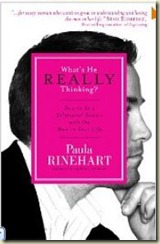
Book Review: "What's He Really Thinking?"
Like every woman, I often wish I better understood the men in my life. Heaven knows, even without setting foot outside my house I have plenty of opportunities to rub elbows with people of the male persuasion. One husband plus three sons (not to mention a male cat) make for an abundance of testosterone all around me. So, after reading some positive reviews of "What's He Really Thinking?" by Paula Rinehart, I decided to give it a look. As the subtitle says, the book is designed to help you to be "a relational genius with the man in your life."
Does this book deliver?
I felt a bit of cynicism when I picked up my copy. Partly, it was because I feared I might, at best, be holding a book of pop-psychology with a "Christian" label slapped onto it. After all, that's what most "Christian" books amount to, these days. Or, at worst, it could even be an angry feminist rant with plenty of male-bashing. This world offers plenty of that as well, and I want nothing to do with it.
But, I had heard good things about this book, so I decided to wade ahead. And I asked my husband to read it as well, because I figured he was more qualified than I am to decide if the book represented his gender well.
I'm so glad I did.
The book is so much better than I had dared to hope for. It fosters a genuine appreciation for the way God designed males, and a desire to get better acquainted with the ones I thought I knew. I felt moved, inspired, and refreshed as I read it.
Perhaps more significantly, my husband loved this book. He underlined, took notes, and at some points was truly quite moved. He expressed thankfulness to me for sharing the book with him, and for having a desire to get to know him better.
Have I become a relational genius yet? No, but I have great hopes that the conversations which will ensue as a result of our reading (and re-reading) this book will go a long way towards increasing our understanding and appreciation of one another.
I would unhesitatingly recommend this book.
------------------------------
Disclosure of Material Connection: I received this book free from the publisher through the BookSneeze®.com <http://BookSneeze®.com> book review bloggers program. I was not required to write a positive review. The opinions I have expressed are my own. I am disclosing this in accordance with the Federal Trade Commission’s 16 CFR, Part 255 http://www.access.gpo.gov/nara/cfr/waisidx_03/16cfr255_03.html> : “Guides Concerning the Use of Endorsements and Testimonials in Advertising.”
Thursday, January 27, 2011
Offending People, Jesus-Style
Image via Wikipedia
This morning I read a blog post by Al Mohler called, "The Osteen Moment – Your Own Moment Will Come Soon Enough." It discusses a recent televised interview in which Joel Osteen squirmed under Piers Morgan's relentless gaze. Piers had asked him the worst question you can ask a "Prosperity gospel" kind of preacher who craves public approval but still feels any allegiance whatsoever to the Bible. Piers asked, "Is homosexuality a sin?"
Dr. Mohler's blog entry pointed out that every one of us who claims biblical Christianity will get hit by that question soon enough. And it left me wondering how I should answer.
There's no question that homosexual activity is sinful and prohibited. The Bible makes that absolutely clear. The question is, how do we present that reality when challenged by the Piers Morgans of our world (or our homosexual next door neighbors, family members, or co-workers)?
Most of the time, we see only a few possibilities. We can evade the question altogether, we can couch it in the most squirmingly cowardly language, or we can barrel on ahead without caring about the feelings of those around us.
Given a choice in our culture, most of us would prefer not to offend. And yet, if we're true to our Bibles, we know that Jesus often chose to be offensive (Mat 15:12-14 , John 6:48-64 , just to name a few). And we know that Jesus did all things well, so it must be okay to offend, right?
Yet we've all met plenty of Christians who not only aren't afraid of offending, but who actually love it. They're arrogant, in-your-face, obnoxious people who give Christ a black eye even as they name His name. In our guts we know that they offend with a different spirit than the one with which our Savior offended people.
How will I answer that question when it comes to me? Most of us go round and round in our minds and end up coming to one conclusion.
I hope nobody asks me that.
Not exactly helpful.
Folks, we're sometimes going to have to offend people. There's no getting around it. The question is, how did Jesus offend people? If we're going to do it, we want to do it His way, right?
When it comes right down to it, Jesus offended people with the Gospel. Sometimes they were offended with the part of the Gospel that revolved around His Lordship. Sometimes they couldn't stomach the way He refused to be chained to their legalistic rules.
But if you boil it all down, the part about the Gospel that offended them most was this:
You are a sinner who needs a Savior, and I am that Savior.
When someone asks us, "Is such-and-such a sin?" and they're waiting with sharpened claws to rip us up as soon as we answer, we become very un-Christlike. We follow the rabbit trail, when Jesus would have gone straight to the heart. The offense of the Gospel does not revolve around whether or not such-and-such is a sin. It revolves around whether or not you and I are sinners.
Right now, homosexuality is the untouchable sin, the rallying point for those who can't bear the doctrine of sin at all. The world says, "Don't you DARE call it sin." To do so is political suicide.
Our Lord never got into politics. He got into hearts and souls. And this is where we lose our edge. We want to let people move the battleground to the arena of action only. The Gospel insists that the arena exists in a much deeper place.
The message of the Gospel is much more offensive than the fact that homosexual acts are sinful. The Gospel tells me that my BEST acts are sinful. That's why, of all the people in Israel in Jesus' day, no one hated Him more than the Pharisees, the religious leaders who were so sure of their own righteousness.
No matter what the question, don't get defensive. Go on the offense with the best offense the Gospel can offer. Because the best offense of the Gospel is one that you can't present arrogantly.
Here's what I hope I would say to Piers Morgan and all those who ask if homosexuality is a sin.
"Piers, you know what? I have something more offensive to say than that. What true Biblical Christianity teaches me is that sin is not just what a person does, it's who he is. Sin is part of my DNA. It infects everything I do, and not just the things that look bad. If I reach out my hand to give $5 to a homeless person, it was a sinful hand that gave the money, and a sinful heart that decided to do even that good act. The news of the Gospel is offensive not because it labels certain things as sins, but because it labels all of us as hopeless sinners in need of a Savior. Did you know that the Bible says that all of our righteousnesses are like filthy rags? That's all of the best things that you can do, Piers, and the best things that I can do. Filthy rags. That's why, though the word 'Gospel' means 'Good News,' it's only good news to people who are humble enough to look at themselves and say, "I am sinful and I need a Savior." The Gospel is the worst possible news, the most offensive news, to the proud person who wants to worship himself. God resists the proud. He gives His grace, His mercy, His forgiveness to the humble. So behind every heart that angrily asks, with fists clenched, 'Is such-and-such a sin?' lies a heart that is yelling at God, 'Don't you dare call ME a sinner.' But for those whose fists are unclenched, for those who see their own sinfulness and hate it, the Gospel is the best news of all, because it says, 'There is a Savior, and He came to earth and lived a perfect life and died a horrible death and rose from the dead to pay the price for all of my sin…ALL of it, no matter what that might look like when it's acted out. He came to die because of the sin that's in our DNA, that infects our very best acts and leaves us desperately lost. That's the Gospel. So don't waste my time with asking me, 'Is ______ (such-and-such) a sin?' No matter what you fill in the blank, the answer is the same. It's either an outright sin, or it's a good act that is still tainted with sin. We need the Savior because we are sinful to the core. All of us. I need the Savior…heterosexual, non-drinking, non-smoking, non-cussing, non-you-name-it me…I need the Savior. And Jesus Christ is that Savior. Those who believe that they are sinners, who know that they cannot impress a holy God, and who put their trust in Jesus to save them and forgive them and cleanse them and make them new, they are saved and forgiven and cleansed and made new because of His mercy. That's the message of true Christianity. And it's much more offensive than what you hoped I would say. Do you believe that you need the Savior, Piers?"
Tuesday, October 26, 2010
Prayer of an Earthen Vessel
Image via Wikipedia
I originally wrote this piece as an entry for the FaithWriters weekly challenge (4/25/08). The topic was "Mother."
Today I read back over it for the first time in a long time, and I find that my heart's cry has not changed. I hope that it is a blessing to others.
-----------------
God, I am so unworthy.
Who am I that you have entrusted me with these lives?
Eternal souls.
Eternal.
Souls.
How can such a sinful heart as mine
Lead other sinful hearts to You?
How can one so weak, so flawed
Hold in her hands three growing heirs of Heaven
Or Hell,
Three temporary shells of
Eternity encapsulated?
Who is equal to these things?
Not I, Lord. Not I.
God, my heart breaks.
I’ve failed, oh how I’ve failed!
And time is racing against me,
Always against me
Inexorable foe
Which has already defeated every mighty one who has gone before,
And I can only cast myself at Your feet and cry
“God, have mercy on me, a sinner
A mother.”
And the mercy for which I plead
Is for them, Lord, for them.
I cannot be what they need me to be.
The best I have to offer them
Is only dust and ashes
For that is what I am,
And it is what I will someday be again.
Help me, God,
For what I want to give them is You.
You, Lord of Forever, shining through me.
Priceless treasure in an earthen vessel,
Heaven’s greatest glory
Hidden under a bushel-basket of sinful self.
Oh God, You have wounded me
With love,
You have crushed me
With mercy.
Now please do whatever you must
To break even more
Until You shine through triumphantly
And I cast no dark shadow across the face of Your glory.
Open their eyes
To see Your blazing beauty
And not the sin which tries to hide You.
Use me to show them Yourself
No matter what it may cost me
For I believe in You
And I know
You are worth it all.
To love You in this way
Is what it means to be a bride
And a daughter.
To love them in this way
Is what it means to be
A mother.
Wednesday, August 11, 2010
Propping up Dagon
Those poor Philistines...
Their god was broken!
The trouble began after they defeated the Israelites and took away the Ark of Jehovah. What a coup that had been! And what more fitting thing could they have done than to bring the disgraced Ark into the temple of Dagon, their god, so that their god could enjoy looking at what he had conquered?
But things didn't turn out the way they'd hoped. The next morning, temple worshipers entered to find that their god had fallen down on its face before the Ark of Jehovah.
Well, that had proven embarrassing, but it had been a simple enough problem to resolve. Just get enough strong men to lift Dagon back up, and then the worship could go on, and all would be well, right?
Except the next morning, when the worshipers returned, they found Dagon prostrating himself before the Ark again, and this time his head and hands were broken off. Yet even after this, the Philistines still claimed Dagon as their deity.
We modern westerners shake our heads at the naiveté of our Philistine brothers of long ago (1 Sam 5:1-7). How could they be so foolish as to worship a statue, and to call something breakable "god?"
And yet God's Word tells us that we are guilty of all the things for which we judge others (Rom 2:1). And last night the Spirit brought the story of Dagon and the Ark to mind and convicted me with it.
I have no right to laugh at anyone. I have broken gods, and I have spent my life desperately trying to prop them up.
I'm willing to bet some of you have done the same.
"No," you may argue. "I don't worship anything that's broken in my life. I hate what's broken in my life!"
Really? Could it be that your hatred proves your worship? Why do you hate the broken things? Is it because you believe that their brokenness is the reason your life is unfulfilled? Doesn't that mean that you believe your fulfillment rests in the longed-for wholeness of those things?
If they were whole, life would be perfect.
Once you prop up Dagon, worship can go on, and all will be well, right? We can ignore the fragility and pretend it never happened.
Did it ever occur to you and me that, if something can be broken, it doesn't deserve the place of a god in our lives? It can't be the source of our soul's deepest needs.
What is my "Dagon?" What is yours? It is anything that we believe holds the key to our lives, our hopes, our dreams, our happiness, our fulfillment, our joy. It could be a certain person, a certain type of marriage or family situation, health for ourselves and our loved ones, a certain amount of money, or anything else.
For some of us, the idol hasn't been broken yet, and we choose to ignore the fact that it's fragile. Worship goes on unabated. But for others of us, the smashing has happened, and it hurts. Oh, how it hurts. We run frantically to pick up broken pieces, we search for the super glue, we sweat and strain and groan to put everything back together on its pedestal so life can go on again. It's our god, isn't it? We need it!
Even atheists have gods that they worship, though they would never call them by that name. But what is worship, if it is not the acknowledgment of the total worth of another, and our abject need of them? And what is a god, if it is not the person or thing that we worship?
Let's look back at the Biblical narrative. Not only had the Philistines' god been disgraced, but Jehovah had struck their city with terrible plagues. How did the Philistines handle their situation?
They acknowledged the superiority of Jehovah to Dagon (1 Sam 5:7), but did they bow before the True God? No, they decided to send Him away by sending away the Ark that represented His presence (1 Sam 5:11). And they created a new sacred ritual to worship the place where Dagon's broken body had landed (1 Sam 5:5).
Is anyone here going to argue that we do differently? What happens if we have to choose between obedient worship of God and whatever our idol might be? Which do we choose, especially in a knee-jerk moment?
How do we respond to God's call to rejoice in Him whatever our circumstances? Do we push Him away and tell Him we cannot possibly rejoice until we get all of the pieces glued back together? Do we resent Him for even implying that we should rejoice in Him when He hasn't fixed our idol for us?
Remember, the Ark of Jehovah sat there in the Temple while the worshipers of Dagon struggled to reassemble their god. The people ignored the Ark and did not worship Jehovah, and Jehovah did not help their repair efforts.
It would have been unloving for Him to have done so.
Last night, the Lord asked me to look at the broken, shattered pieces lying all around me, and He gently told me to stop trying to prop Dagon up.
Put down the shards. Turn around and look at Me. I am not broken, nor breakable. Your life might be easier with those pieces put together, but then you would worship them, and miss out on Me. Many unbelievers have the things you long for. Would you trade places with them? Do you really believe that these things you've spent your life longing for actually hold the key to life for you?
No, Lord. I had not realized that I was worshiping the image of a rebuilt idol. But I was, wasn't I? I believed everything depended on my fixing what was broken, or even on YOU fixing what was broken. Either way, my hope was in the wholeness of something other than You. But Your wholeness is eternal. I have been a fool. I do not need these things to be repaired. I only need you.
What does this mean in my life? Does it mean some sort of castle-in-the-sky spiritual aloofness? Do I tell others that they don't matter to me anymore, because I don't need them?
No, just the opposite. You see, worshipers are characterized by need. We need what our idols give us, whatever that may be. And when our idols prove to be less than infinitely rewarding (as idols inevitably do), we needy people tend to become demanding, self-centered, leechlike. The ugliness of our grasping may not be clear as long as we're getting what we want, but even so, we do not love as Christ loved. We love as the child loves the lollipop, as the addict loves the needle.
I love what you do for me. Period.
But what if I cease to have idols? What if I draw close enough to Christ to find my life in His infinite sufficiency? What if I no longer need to draw life from the people or things around me?
The closer I come to Christ, the less I will feel like hating the brokenness, or the broken people. They can't "let me down" if I am not demanding their wholeness to feed my soul. I will be patient with the brokenness, and will love the broken people, if I, in my own brokenness, find my life and my healing from Above. And ironically, when I cease demanding and start loving, God may use me to help heal the brokenness around me like never before, because my efforts will be acts of love, not attempts to rebuild an idol.
At least, that's what the Lord is showing me. Now to learn to live in the light of that truth…
I've got a long way to go.
--------------------------------
Yes, I've been gone a long time, and no, I didn't disappear off the planet. But life has happened, and life needs God's merciful intervention. Please pray for our family whenever you think of us. Thank you!
Tuesday, June 8, 2010
My Brother's Testimony
Brother and sister, Rex and Betsy Lewis, 1982
My brother and I, not too surprisingly, share many things in common. One of those is having been saved much later in life than we originally thought.
This past Sunday my brother was re-baptized, so that he could experience baptism as a truly converted person. As part of the service he gave his testimony, and he has kindly given me his permission to share it here.
His life story, like mine, makes many people nervous because it underscores the tragic fact that false assurance really does happen to people. But it's vital for people like my brother and me to share our stories, because they can help others to examine themselves as the Scripture commands us to do.
I hope his testimony, given in its entirety below, blesses you as it blesses me.
------------------
I grew up in a home that had a thin layer of what looked for all the world like Christianity, covering a mountain of hypocrisy. My parents were founding members of our church and we children rapidly learned how to fit in. I made a profession of faith at a very early age and became the poster child, so to speak, for our church; filled with promise for a fantastic future of service to God. I could clearly describe the Gospel of the death, burial and resurrection of Christ and believed the facts. But God had not wrought the truth of it in my heart. I guess you could sum up my view of things with the phrase, “God is really blessed to have me on His team.” The problem is, it was all a sham; a sham that even fooled me. I guess you could sum up God’s view of things the way Jesus did.
Mat 23:27, 28, “Woe to you, scribes and Pharisees, hypocrites! For you are like whitewashed tombs, which outwardly appear beautiful, but within are full of dead people’s bones and all uncleanness. So you also outwardly appear righteous to others, but within you are full of hypocrisy and lawlessness.” Or, as He said later to the church in Sardis, “I know your works. You have the reputation of being alive, but you are dead.”
I waited until I was in Bible College to be baptized, mainly because my father believed that baptism was not for the Church age. At the time I was being baptized at a beach in the southern part of Pinellas County, the presence of two coast guard boats and a helicopter searching for a body made for a strange ambiance. Little did they know that right near their search grid, a dead man was being baptized.
With that foundation of hypocrisy firmly in place, I entered full time ministry. After “serving God” in Miami and Tampa, I began to prepare for overseas “service.” During that time of training and preparation, God opened my eyes to the pharisaism in my heart. I went through a major transition in my theology as God allowed me to learn the truth about many of the Scripture’s great doctrines. I don’t know why God chose to do things the way He did, perhaps he will let me know some day, perhaps He won’t. But the revelation of my hypocrisy was only the beginning of a period of over 10 years where I was in ministry but was unsaved for most of it. Though He taught me many wonderful things about the Gospel, He still had not made the Gospel’s effect real in me. I guess we could sum up my view of things during that time by saying, “I am so happy that I know these things.” But I think we could sum up God’s view of things by what Jesus said, John 5:39, 40, “You search the Scriptures because you think that in them you have eternal life; and it is they that bear witness about me, yet you refuse to come to me that you may have life.” I understood that Jesus had died and risen again because of my sin. I understood that I had to believe in Him, and I did believe. But I really didn’t know what it meant to repent. I didn’t know just how terrible my sin was that I needed to repent of. What’s more, God had not yet given me the sweet gift of repentance unto life. Gradually, I began to see my evil more clearly. I began to see it in the light of God’s holiness. It brought me to the place where I, though I wanted to be right with God, was willing to accept His eternal condemnation if only He would be glorified by it. It brought me to the place where I was hanging for my life on the truths that I had so confidently believed all those years.
Some time later, God challenged me with 2Co 13:5, “Examine yourselves, to see whether you are in the faith. Test yourselves. Or do you not realize this about yourselves, that Jesus Christ is in you?--unless indeed you fail to meet the test!”
What God revealed to me through that examination was that there is, indeed, a new dimension to my life. Although I still struggle with the flesh, the fear of man and the desire to impress, there is now something within me that operates on the level of eternity instead of time. For instance, instead of merely refraining from outwardly doing the evil that I secretly long to do, I sincerely long for sin to be defeated in me and long for the day when I will be totally free from it. Instead of just believing a set of doctrines, I now depend on their truth in my own life and seek to understand what they reveal about the character of my God. I really can’t nail down the moment when the change occurred. I only know that I can’t trace it back all that far. And I can rejoice that it has happened. I guess you could sum up God’s view of things now by what He said through the prophet Jeremiah, “I will give them a heart to know that I am the LORD,” and what He said through the writer to the Hebrews, “I will put my laws into their minds, and write them on their hearts, and I will be their God, and they shall be my people.” And I guess the best summary of my view is, “Thanks be to God for his inexpressible gift!”
Rex Lewis