Showing posts with label God-Centeredness. Show all posts

Tuesday, March 1, 2016

What Can You Give to God Every Day?

Photo by Robert Hurst 


Not long ago I felt inspired by this post from my favorite blogger, Tim Challies.  It is about consciously dedicating things like your time, energy, and enthusiasm to God every morning.  I decided to start praying through them in the mornings, and soon I found myself adding more.  I thought I should share these with you, because I find them very helpful in my own walk.  (Not that I'm an expert in living this way...far from it!  But this is the direction I believe He wants me to grow.)
Please let me know in the comments if you think of anything else that would be helpful to add to these morning prayers!

My morning dedications:

  • I dedicate to You the gifts and talents that You have given me, to be used for Your glory.
  • I dedicate to You the time that You have given me, for I am only time's steward in Your service.
  • I dedicate to you the energy You have given me, for pursuing Your will.  I will trust You to supply moment-by-moment energy when I have no supply of my own.
  • I dedicate to You my enthusiasm, for Your joy and Your promises to shine through.
  • I give to you my cares and anxieties over the circumstances You have given me, for the praise of Your peace and Your sovereignty.
  • I dedicate to You my reputation and honor, for You to raise or lower in the eyes of man as You see fit, because You laid aside Your glory for me, and You have promised to clothe me with Your glory forever.
  • I dedicate to You my weakness, to be used for the glory of Your strength, rather than using it myself as an excuse to bury what You have entrusted to me (Matt 25:14-30).
  • I dedicate to You my thoughts and imaginings, because Your thoughts are higher than my thoughts, and You have prepared blessings for me that are beyond imagining.
  • I place on your altar my self-sufficiency and self-confidence, to replace with Your sufficiency, and with confidence in You.
  • I dedicate to You my best-laid plans, for You to establish or overrule as You see fit, because Your plans are perfect.
  • I leave in Your hands every "sacrifice" I've given, not trying to control what You do with them.  If you are pleased to make them into obvious blessings, or to burn them to ashes on Your altar, I will rest in Your acceptance of them.  I will trust You that nothing is lost.
  • I dedicate my all to You, Lord.  You gave all to me, and You have told me that all things are mine in You (1 Co. 3:21-23).


Wednesday, October 1, 2014

I Can Do What Things?

English: Saint paul arrested
English: Saint paul arrested (Photo credit: Wikipedia)
The great Apostle Paul said, "I can do all things through Christ who strengthens me."

So why didn't he pray up an earthquake to rescue himself from prison every time he was in there, like the one that rescued him and Silas in Philippi?

Why didn't he power his way out of floggings and stonings?

Why didn't he just keep those ships afloat instead of suffering shipwreck two times?

Why didn't he pull together a slick presentation that wowed everybody's socks off and made everybody fawn over him, instead of being slandered, beaten, hated, and drummed out of town all the time?

C'mon, Paul, why didn't you do those things?  Don't you know what you wrote?  Don't you know "all things" means ALL THINGS?  You should be healthy, wealthy, and loved everywhere you go!

You should be enjoying your best life now!

But what if "all things" doesn't mean "everything we want?"  Everything we think is best?

Does "all" always mean "Anything in the universe," or does God say "all" within pre-defined parameters?

When I took my little kids to the store and (on rare occasions) pointed to the candy display and said, "Pick whatever you want," was I inviting them to rush away to the sporting goods section and pick out a bike?  Of course not!

What are our parameters?  What are the limits of God's "all?"

Paul knew what God's power in his life was for.

I have learned in whatever situation I am to be content. I know how to be brought low, and I know how to abound. In any and every circumstance, I have learned the secret of facing plenty and hunger, abundance and need. I can do all things through him who strengthens me (Php 4:11-13).

Paul knew that God's power was there to enable him to suffer well.  He also knew that God's power was there to enable him to receive God's pleasant gifts unselfishly, and to use them for ministry rather than for his own luxury.

And where did he get this perspective?  Do you remember what God promised when He told Ananias about His decision to save Paul and use him for gospel ministry?


"I will show him how much he must suffer for the sake of my name.” (Acts 9:16)
"Well that's all well and good for Paul," you may say, "but God never said anything like that to me!"

Didn't he?  Have you ever read Luke 6:20-36?  Were His disciples lying to the suffering Christians in Acts 14:22?

Jesus probably hasn't told any of us what we're going to suffer, but He has promised us that we will suffer (John 16:33).

So if "all things" doesn't mean delivering ourselves from suffering, then what good is it?

It means that whatever God has put in your life, whether suffering or pleasure, He will enable you to turn both of these temporary things into eternal treasures as you endure or enjoy them with contentment.

"I have learned to be content in all circumstances...I can do all things through Christ who strengthens me."

Christian power doesn't come by rebuking so-called "demons of whatever I don't like" (which we'd better be cautious about doing anyway, Jude 1:8-10).  It doesn't come by "naming it and claiming it" (2 Co 12:8-9).  

Christian power comes through the immovable strength of contentment in Christ Himself.  Contentment, in fact, is nothing more than the peace which comes from faith in a good and loving God who will "work all things (including suffering) together for the good of those who love Him" (Rom 8:28).

Contentment strengthened Paul to go back to minister in places where his life was threatened.

Contentment strengthened Paul to sit in a dank, filthy prison, chained to guards night and day, with his back lacerated by brutal whippings, and to write epistles which overflowed with love, praise, and joy.  And every time we read Paul's epistles, we who love God are still receiving the promised "good" which God brought from those incredible sufferings.

Will you pray for the faith-filled contentment which is the only thing that will empower you to love and serve and praise and rejoice in the midst of your tears and tiredness?

Godliness with contentment is great gain indeed (1 Tim 6:6).


Wednesday, July 23, 2014

Prayers For Daydreamers (And Other Mental Escapists)

Photo by Vera Kratochvil        


I confess, I'm a daydreamer.

Okay, to be more honest, I'm an extreme daydreamer.  Or perhaps "pathological" would be a more honest word.

Perhaps you don't daydream...but you DO fill up your mind with other people's imaginations in the form of novels, TV shows, and movies.  Or perhaps you feast your mind on endless video games.  Whatever your mental escape may be, it's probably fine in small doses.

The problem with me was, daydreaming became a drug.  It became Escape.  I never had to "be there" mentally, even if I was there physically.

Do you have a problem with mental escapism?  Perhaps, like me, one of the reasons you find it easy to slip into "escape mode" is that it's hard to see what's wrong with it.  If that describes you, and you really don't feel like you're missing out on anything by excessive escaping, you'll definitely want to prayerfully consider the requests I've written below.

Or, perhaps your form(s) of escapism have become an addiction...as I'm ashamed to admit they have with me. Especially my imagination; my skill at weaving compelling dramas in my head.  It's so much a part of me that I hardly feel like it's optional.  The stories are always there, always waiting, always beckoning, always entertaining, always seeming to fulfill a need.

In fact, our mental escapes are far more responsive than God is.  We've got to wait on the Lord, but entertaining screens are never far away.  We never have to wait for our imagination either.  And how do you walk away from a drug that literally resides inside your head?  There's no passing by the fantasy counter, the way people can choose to pass by the cigarette counter.

But after a while, as Christians, we have to come to terms with the fact that we love and trust our oh-so-available escapes more than we love and trust the God we can't control.

Then what do we do?

Scripture tells us that conquering bad habits by mere force of will doesn't make us righteous before God.  That's the Pharisaical approach, and it only trades the original sin for the greater sin of religious pride.

Romans 8 tells us that we must put sinful deeds to death "by the Spirit."

And how does the Spirit work?  He works by drawing us to read the Scriptures, illuminating it to our minds, helping us love and revere God as revealed in His Word (and to love His word for revealing Him to us), recalling the truth to our minds (especially if we memorized it), teaching us to love what God loves and hate what God hates, and changing our hearts to want to obey Him.  In this way, He turns our hearts onto the right paths.

So I decided to attack the problem of excessive daydreaming with some specifically targeted prayers, ones which help me aim for ways to pursue a joy in Christ that's better than mental escapism.  And I thought I'd share them with you, in case I'm not the only one with this problem.  So without further ado, here are:


Prayers for Daydreamers
(and other mental escapists)

1. Father, instead of daydreaming/mentally escaping today, may I love the Lord my God with all my mind.  If love is spelled "T-I-M-E," then my mind is loving its constant escapes more than I love You.  Help my mind to be set on You and seeking you more and more of the time.

2. Instead of daydreaming/mentally escaping, by Your grace may I obey the command to "Love my neighbor as myself."  Because the fact is, I can't recognize my neighbor's needs or prioritize them in my life if I'm wrapped up in my fantasy world. 

3. Help me to "Walk as as child of light, trying to discern what is pleasing to the Lord" (Eph 5:8-10).  I can't be constantly trying to discern what is pleasing to the Lord in my real circumstances if I'm daydreaming about being in different ones.

4.  Help to obey Your command that says, "Whatever you do, work heartily, as for the Lord and not for men."  Forgive me, Lord, that I used to think this meant "Try not to mind the work by distracting myself with my imagination."  After all, what's heartier than my imagination?  But no, it means putting my heart into the work itself in order to lovingly serve others and willingly obey You in the situation You've actually created for me.  It means "redeeming the time," in my real world.

5.  Spirit, please help me to "In everything give thanks."   Daydreaming prevents me from noticing things to be thankful for, or from even committing to noticing them.

6. Help me to remember that I can't "Behold the Lord and be changed into His image, from one degree of glory to another" (2 Co 3:18) if I'm constantly beholding the contents of my imagination instead.

7.  Help me, Spirit, to obey the command: "You shall meditate on God's Word day and night, that you may be careful to do it."  Ignoring Your Word is the same as disdaining Your commands, Your promises, and Your blessings.  It means not caring whether I obey You or not.

8. Help me to "Pray without ceasing."  I clearly can't do that while mentally escaping into fantasy or video games.

9. Help me to receive the blessings of Truth, such as sanctification (John 17:17) and freedom (John 8:32).  All commands, promises, and blessings related to Truth are blocked by an insistence on living with the mind marinating in what is not true. The blessings of Truth can only be applied to my actual reality, even in all its periodic ugliness.

10. Help me to cooperate with You as You prepare my heart to "Go to Him outside the camp, bearing His reproach" (Heb. 13:13)  In our daydreams we feed our lust for glory, we dream of human accolades, we focus on mastery rather than dependence, and we further unfit our hearts for bearing His reproach.

Can you see how different this is from "white-knuckle fighting" with our sin?  By the Spirit we seek to love God more, to find our joy in God instead of in sin.  He alone makes that possible, because we can't change our hearts ourselves.  But we can and must choose to seek Him, to "fight the good fight" against our tendency to believe the promises of sin more than the promises of God.  We can and must pray and wrestle and repent in the fight for the greatest joy there is...the joy of believing and knowing Him.

Wednesday, March 26, 2014

When I'm weak, then I'm strong? Why?

Power Board
Power Board (Photo credit: yum9me)

For the sake of Christ, then, I am content with weaknesses, insults, hardships, persecutions, and calamities. 
For when I am weak, then I am strong. 
(2 Co. 12:10)


I memorized this verse when I was a teenager.  (Let's not talk about how long ago that was, please!)  And I thought I knew what it meant.

Somehow, when I'm weak, then Christ comes and bolsters me up to accomplish what I wanted to accomplish by His strength instead of mine.  


In other words, His strength looks and acts just like mine, except on steroids.


Is that what it means?  I wonder.  In fact, I doubt.

Is Christ just the proper power cord for my goals?  Does "plugging in to Jesus" feel like a power rush, ready to mow down the world?  Or have we got this "power vs weakness" thing wrong?

I read this helpful article a little while ago, and it got me thinking.  Here's an excerpt from a comment I wrote there:
     Slowly, slowly, I'm learning that godly parenting isn't about wielding human power but extending grace in wise ways.  And whenever I forget that, whenever I start trying to be powerful again, I get ugly again.


     The beautiful power of humble grace doesn't feel like power at all, but it does more good than all of my prideful/terrified power-grabbing could ever do.
Does this sound like a "Jesus is my power cord" theology?  Not to me it doesn't, and I'm glad.  But until I wrote it down today, I didn't realize just how radical it was, or how much I still default to wrong-headed "power cord" thinking.

Why, in Christ, am I strong only when I'm weak?  Perhaps we can't understand that until we define our terms.  What, in God's eyes, is strength?  What is weakness?

"Strength," as the Bible promises and commends it, is the power to accomplish God's will, not my own.  Such strength was displayed most clearly in two places that I can think of.  First, during Jesus' wilderness temptations, when he was starving, but refused to use His power to relieve His hunger without authorization from the Father.  And second, at Gethsemane, where Jesus prayed, "Not my will, but thine be done."

"Strength" - the kind which is promised and commended - is the power to do things which have eternal Kingdom significance, as opposed to things which will burn up on the Day of Judgment (1 Co. 3:13-15).  Such strength most often shows itself in Christ's life in acts of humility and sacrifice.  There were "Temple cleansing moments," but those were very much in the minority (and were still done in godliness, but that's a different subject).

By contrast, my strength, human strength, is an ugly, grasping thing when it doesn't have what it wants.  It gets violent, in words if not in deeds.  Human strength has done much good (at least temporarily), and it has done much evil.  It has gone as far as genocide many times in our history.  And yet, in God's eyes, it's puny.  Laughable.  It will come to nothing.  (Ps 2.)  In fact, it's weak.

Human strength is weak.

But what is "weakness?"  Specifically, what is the weakness which is commended, which is sought, which is boasted in (2 Co 12:9)?  Surely God doesn't commend the weak, futile rage of the earthly strength in Ps. 2.  So what weakness does He commend?

Could it be that He loves the weakness which not only lacks human power, but disdains it?

When I have felt powerless as a parent, yet have yearned for power, and have felt angry and hopeless because I didn't have it, was that the weakness that God commends?  Or was it the weakness that makes me ugly, grasping, enraged and snarling like a trapped tiger?  Isn't yearning for human power just as weakening as having it?  Doesn't it leave me just as powerless to do eternal good?

Do I just need to "plug in" to Jesus to regain the power my flesh craves?

Or do I need to recognize that human power always gets it wrong in the end?  Do I need to turn my back on it and go the way of God's power...the way of humble grace, of love and service, of meekness...and discover the hidden, gentle power there?

If you truly believe in the meekly Crucified One who lives...who died in weakness and is mighty to save, and who is exalted above every other name...then you don't need me to answer that question for you.

Blessed are the meek, for they shall inherit the earth (Matt 5:5).


Enhanced by Zemanta

Friday, March 5, 2010

Quotables for 3/5/10

"Talking bubbles" by iprole

"I have noticed among domestic servants one very common reason of unsettlement. It is that they do not know who is the mistress and have to take orders from half a dozen people. And all of us are servants in God's house, and always in our service we shall be irritable unless there be one voice we must obey and one will which gives us all our orders. That was the meaning of the peace of Job. He saw God always, and he saw Him everywhere. "The Lord hath given, and the Lord hath taken away," said Job, "blessed be the name of the Lord." It was not God today and fate tomorrow. It was not heaven in the morning and blind chance at night. Through light and shadow it was God to Job, and that was one secret of his rest. So is it with us all. To have many masters is always to be restless." ~ G.H. Morrison

---------------------------

"No one can serve two masters." 

(Jesus, Matt 6:24)

Friday, February 19, 2010

Quotables for 2/19/10

"Talking Bubbles" by iprole

"You may have stopped following Jesus, but now you want to follow again. When you stopped following Jesus, you did so on your terms. But the returning to Jesus is strictly under His conditions. He is God, and you are not. Are you willing to follow Jesus anywhere, at any time, under any condition? That is the only way you can follow Him."

~Blackaby, "Experiencing God Day by Day."

-----------------------------------

(Regarding 1 John 3:22-23)

"Prayer has a specific purpose. God designed it in wisdom to fit his perfect way of working in the world. If you misuse it, it malfunctions. What then is the design of prayer? I think these verses show that prayer is designed by God to be the effect of faith and the cause of love.

Therefore if we try to pray when we really do not believe in the name of God’s Son, or if we try to pray when our aim is not love, prayer malfunctions.

'We receive from him whatever we ask, because we keep his commandments.'  This does not mean that keeping his commandments earns answers to prayer; it means prayer is designed to give power in the path of obedience. That is what it is for. Prayer is God’s way of making himself available for us when we are pouring ourselves out in love for others. Prayer is the power to love. Therefore if we do not aim to love, we pray in vain. Prayer is not designed to compound hoarded pleasures."

~John Piper in "A Godward Life" 

--------------------------------

"Drudgery is one of the finest tests to determine the genuineness of our character. Drudgery is work that is far removed from anything we think of as ideal work. It is the utterly hard, menial, tiresome, and dirty work. And when we experience it, our spirituality is instantly tested and we will know whether or not we are spiritually genuine. "

~Chambers, "My Utmost for His Highest."

----------------------------------

Thank you for letting me share with you a few of the things that touched my heart in this morning's devotions.  May the Lord bless you!

Wednesday, February 17, 2010

Wearied by Sacrifice

High priest offering a sacrifice of a goat, as...

Image via Wikipedia


My Bible reading schedule has me in Leviticus right now.  If you know the Bible, you know what that means.  I'm reading regulation after regulation regarding the various types of sacrifices for the various types of sins.

I often find it to be rather tiresome going.

Haven't you ever thought about it…how quickly you would have gotten sick of hauling animals to be slaughtered, toting flour cakes and drink offerings and you-name-it to the Temple, every time you sinned?  I never would have gotten anything else done!

As those sorts of thoughts flitted through my head this morning, the Spirit whispered a bit of perspective.

Are you saying you're glad that it's easier to get away with sinning as a Christian?

Oof.  That hit like a punch in the gut.  It's amazing how a still, small Voice, speaking gently, can pack such a wallop.

I had to step back and examine my whole perspective.  And the first thing that came to mind was just exactly how God felt about those who were wearied by sacrifice:

Oh that there were one among you who would shut the doors, that you might not kindle fire on my altar in vain! I have no pleasure in you, says the LORD of hosts, and I will not accept an offering from your hand… You say, 'What a weariness this is,' and you snort at it, says the LORD of hosts…Shall I accept that from your hand? (Excerpted from Mal 1:10-13)

Every other time I've ever read that passage over the years, I've felt sympathy with those who complained about the 'nuisance' of the sacrifices.  But subconsciously I was saying that, if I had lived in those days, I would have wished I could just sin freely and get away with it!  I mean, come on, God!  Get over it!  Why do You have to make such a big deal about it? I might not have had the guts to put it in those words, but that's what I was feeling.  The sacrifices were a total drag.

But that attitude toward the Old Testament sacrifices supports one of the heresies I most despise in modern Christendom…the idea that Jesus' sacrificial death on our behalves accomplished "carefree sinning" for us. 

It's true that Jesus was the Final, Perfect Sacrifice, and that we no longer bring offerings to any Temple for the forgiveness of our sins.  And praise God for that!  But the way we look at that fact reveals a lot about our hearts.

Are we "sin-centered" or "God-centered?"

A sin-centered person in Old Testament times would have resented the sacrifices.  A sin-centered person in the age of Grace is thankful for Christ's sacrifice…but not for the right reasons.  Such a person is thankful because they believe they've gotten a "Get out of jail free" card. 

The sin-centered person in the Old Testament may have brought sacrifices, but God did not receive them from his hand.  They did him no good.  And a sin-centered person in the age of Grace cannot hope to invoke the holy name of Jesus as an excuse to freely wallow in the very slime that Jesus died to save them from.

Think about this…the "blood money" that Judas got for betraying Jesus was so unholy that the Chief Priests wouldn't accept it into the Temple Treasury (Matt 27:6-7), even though they were the ones who had originally paid Judas that money in the first place (Matt 26:14-15).  They recognized that the money was dirty because it had paid for a grievous sin to be committed.

Those who view Jesus' blood as their "ticket to sin" are in essence calling His blood "dirty money" which pays for sin…not for salvation from it, but for the free continuation of it!  They are calling His blood an unholy thing, unfit for use in any sacred context.  Surely it is for such people that Heb 10:29 was written!

A God-centered person in the Old Testament would have loved coming to the Temple with their sacrifices.  Why?  Because they loved the fact that they could be restored to fellowship with their God, the source of their joy (Ps 43:4)!  For them, their own sinfulness was the "nuisance," and the sacrifices were a blessed way to be renewed in their fellowship with the God they loved. 

For the God-centered person of the New Testament, Jesus' sacrifice is a never-ending wonder.  They cannot fully comprehend why God would have given them the forgiveness and cleansing they need to freely return to fellowship with Himself, to righteousness, and to godliness (not to sinning)!

The lover of God, who comes to Him through Christ alone, has nothing to fear from Heb 10:29 when he sins.  Such a person hates that he has broken fellowship, and can rejoice that the precious blood of Christ has bought his forgiveness and cleansing and restoration to fellowship.  He does not profane that blood, or insult the Spirit of Grace.  He sinned, and it was horrible of him, and he does not take it lightly.  But he sees Christ as his Savior from sin, not as his sin-enabler.  And that makes all the difference.

The lover of sin, who comes to Satan's altar with the blood of Christ on his hands as his "escape clause," is the one who needs to tremble at this verse.  Oh adulterer, what is His blood to you, that you should think to pour it out on the filthy shrines of His sworn enemy; that you should raise your chalice of sin along with all the fiends of Hell to toast His grace with mocking lips?  Do you sing "Amazing Grace, How Sweet the Sound" at your orgies of wicked indulgence?

What is His blood to you?  What is the Holy Sacrifice?  Is it really there just to remove the "nuisance" of Temple sacrifices and make sinning easier for you?  If you had lived under the Law, would you have scorned the way of atonement that God made, or would you have rejoiced that He should have made any way back into His sweet presence at all?

Are you sin-centered, or God-centered?

Which am I?

Examine yourselves, to see whether you are in the faith. Test yourselves. Or do you not realize this about yourselves, that Jesus Christ is in you? —unless indeed you fail to meet the test! (2 Co 13:5)


Reblog this post [with Zemanta]

Saturday, December 19, 2009

Love's Transforming Power

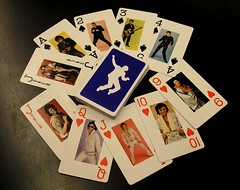
King's Cards! Elvis Impersonator Playing Cards

Image by Archie McPhee Seattle via Flickr

Does it matter what we love?

There are two ways that I can think of to address that question.  One is, "Do the objects of our love matter?"  And the other is, "Do the consequences of our love matter?"  Today I'd like to look at the second question, because I believe we are destined to become like what we love.

We live in a hedonistic culture which loves its entertainment, even the most depraved varieties.  And many, even within the church, will scoffingly ask, "What does it matter?  What's the harm in it?"

Does it matter what we love…what we focus on, what we commit our time and energies to, what we're devoted to?

Devotion…now there's an interesting word. Webster's Online Dictionary defines it as:

1 a : religious fervor : piety b : an act of prayer or private worship —usually used in plural c : a religious exercise or practice other than the regular corporate worship of a congregation
2 a : the act of devoting <devotion of time and energy> b : the fact or state of being ardently dedicated and loyal

Wow...love, devotion, and worship are very closely related, aren't they?

Does it matter what we love?

You shall love the LORD your God with all your heart and with all your soul and with all your might. And these words that I command you today shall be on your heart. You shall teach them diligently to your children, and shall talk of them when you sit in your house, and when you walk by the way, and when you lie down, and when you rise. You shall bind them as a sign on your hand, and they shall be as frontlets between your eyes. You shall write them on the doorposts of your house and on your gates.

Deut 6:5-9

Those who love the Lord as commanded…aren't they really the only ones who are likely to teach His word diligently, to walk a life of integrity before their children, to pass on His legacy to the generations to come?

One of the things that love does is beholding…gazing at the object of its affection.  What effect does this have on us?

And we all, with unveiled face, beholding the glory of the Lord, are being transformed into the same image from one degree of glory to another. For this comes from the Lord who is the Spirit.

2 Co 3:18 

We are transformed according to our love.  There is no neutrality.  Should we really be surprised by that fact, when love, devotion, and worship are so closely tied together? 

So what happens to those who give their devotion to the idols of this world…gold, silver, the latest gadgets, the trendiest amusements?

Their idols are silver and gold, the work of human hands. They have mouths, but do not speak; eyes, but do not see. They have ears, but do not hear; noses, but do not smell.   They have hands, but do not feel; feet, but do not walk; and they do not make a sound in their throat. Those who make them become like them;
so do all who trust in them.

Psa 115:4-8

We find a similar "transformation" mentioned here:

Thus says the LORD: “What wrong did your fathers find in me that they went far from me, and went after  worthlessness, and became worthless?

Jer 2:5

Our idols, whatever they may be, are spiritually dead and worthless.  Do we really want to become like them?

Perhaps nowhere in Scripture is the dangerous aspect of love's transforming power spelled out more clearly than here:

They…became detestable like the thing they loved. Hos 9:10b

It would seem that we have serious choices to make.  Do we want to behold Him and be transformed from one degree of glory to another, or do we want to fix our hearts on sin and become detestable ourselves?  What affections will we encourage, feed, and finance in ourselves and our children?

Beloved, we are God's children now, and what we will be has not yet appeared; but we know that when he appears we shall be like him, because we shall see him as he is. And everyone who thus hopes in him purifies himself as he is pure.

1 John 3:2-3

Reblog this post [with Zemanta]

Sunday, November 22, 2009

Faith: A Work and a Fight

Boxing is a traditional Western combat sport.

Image via Wikipedia


We are saved by grace through faith, and not by works.  Nothing could be clearer in Scripture (Eph 2:8-9).  The faith that saves is a gift from God (Eph 2:8).  It is He who draws us (John 6:44), it is He who keeps us (1 Pet 1:5 NKJV), and it is He who circumcises our hearts to love Him that we may live (Deut 30:6).

And yet we are told that believing on Jesus is a work that the Father has given us to do (John 6:29), and that faith is a fight (1 Tim 6:12). 

How can that be?

I'm in need of that good fight right now.  I'm struggling with a particular temptation.  It doesn't matter what it is, and it's best if I don't tell you, because I want you to put yourself in my shoes with your own struggles, and fight the fight along with me.

If the Spirit of God does not yet reside in you, what I'm about to write does not apply.  What you need is a different, yet still miraculous work of the Holy Spirit.  I hope you'll start your journey by clicking on that link and reading more about it. 

When God brings a dead soul to life, it changes everything.  But nothing can really change until He does that work in you.

It is vital to understand that the fight of faith is not a struggle to believe out of thin air.  It is not a blind leap.  It is not closing your eyes and saying, "I do believe, I do believe, I DO believe!"  Save that nonsense for Peter Pan.

The fight of faith is a struggle to believe in what God has already revealed to you within your heart when He placed His Spirit there.  It is fought by those who are already made new from above, but are wrestling with the remaining weakness and foolishness and darkness which continue to plague us all in our mortal flesh.

How is this battle fought?

First we must understand that all sin is a failure of faith.  All wavering is a weakness of faith.

Here's where I'm weak, and where I often fail.  I'm tempted to believe that sin will give me much-needed relief.  I bet that's where your faith stumbles sometimes, too.

I can preach against my sin using Scripture (as in, "Thou shalt not…"), but that's likely to lead to one of two possible outcomes, neither of which is what I desire. 

  • I can rebel against the commandment
  • I can hold myself back from the desired behavior, but with resentment and a sense of "missing out on the best."

Both responses lack faith.  They completely miss the boat.

I want to use Scripture to preach my soul toward Christ.  I want to remind myself that at His right hand are pleasures forevermore (Ps 16:11), that He is my Life (John 14:6, Col 3:4), that my joy is found in Him (Neh 8:10), that He is truly my deepest desire (Ps 42:1-2).  When I re-connect with these truths (which I already know to be true, because I have experienced Him), I find the strength to fight off temptation with the power of a greater desire.  And in this victory God is honored, desired, and glorified, not resented as inferior to some sin I'd really rather have.  

I don't have to make-believe.  I just need to renew my belief right now, at this moment, when my flesh is weak.

That is the good fight of faith.

Or what about this other facet of my unbelief?  I want to rationalize that my sin will just be a brief jaunt…so short it will be harmless.  How do I fight that?  By reminding myself that God's Holy Word describes sin as a snare or trap (2 Tim 2:26), and as a fiery dart (Eph 6:16).  It warns me that a momentary lapse can cost me for a lifetime (Gen 25:29-34, 2 Sam 12:10), and that God will expose everything on Judgment Day, if not before (2 Sam 12:12).  I can remind myself that dabbling in sin is like throwing rocks at a Tyrannosaurus, because I'm engaging myself in a macabre dance with powers far stronger than myself, bent on my destruction (Eph 6:12).  All of these truths are helpful, but I want to take my fight further.  Anyone, even the unsaved, can restrain themselves if they fear the consequences enough.  There is some faith in believing God's warnings, but the good fight of faith is so much more than that.

The good fight of faith always reorients us to God through Christ, and results in His honor and glory.

How do I fight this "It won't really hurt me" mentality towards sin?  By realizing that what happens to me isn't even the paramount issue.  The question is not, "What will my sin do to me?" but "What will it do to the glory of God?"  Can I claim to have true faith if I don't care about His glory?

True faith always glorifies God, but all sin belittles Him.  Do I believe He deserves to be revered as Holy, and to be publicly proclaimed as superior to sin?  Do I agree with His attitude towards sin…an attitude of hatred so severe that it led to Calvary?  If I don't take sin seriously, then what on Earth does Calvary even mean to me?  What's the basis of my Christianity if it ignores what Calvary means?  What kind of faith do I have if I want to make a pet of the viper whose head Christ has crushed?  Will I so dishonor Him as to try to waltz with His mortal enemy?

If I am not moved by such arguments, I need to do some serious examining of my faith.  I may have believed some facts about what Jesus did in history, but I cannot truly believe that He is all that He said He was, that He is the holy Son of God, and still believe that it's a trivial thing to spit in His face "just for a moment."

All of these thoughts are good, but if I seek to apply them in my flesh alone, I'll still not be fighting the good fight of faith.  And so I pray:

Lord God, in this time when I feel weak, please help me to believe what I already know to be true; to remember what You have already revealed of Yourself and Your worth and Your glory.  Help me to overcome the deceitful allurements of sin with the truth of Your superior delights.  Help me to refuse sin as only the first step of this fight, and to embrace You more tightly as the second.  Be glorified in my life today.  In Jesus' Name, Amen!


Reblog this post [with Zemanta]

Saturday, November 14, 2009

A Note to a Discouraged Friend

A friend has kindly given me"Ship" by marindbk permission to reproduce this note here (with personally identifying content omitted).  I'm sure there are lots of folks facing discouraging situations in this world.  If you're one of them, or know someone who is, I pray you'll find some encouragement here.

---------------------

Remember, a successful day cannot be measured by any of the gauges that the world uses. Success in God's eyes is measured in only one way...faithful dependence with love.  Even if you can't feel those things, just the stubborn act of seeking them is success. No one can prevent you from seeking Him, and He will be found by you when it's time.

(Of course you have truly found Him for salvation...but there's a day-by-day "finding" because we're all so blind!)  All of your other plans and hopes and dreams can be thwarted, but if your heart's cry is, "To whom else shall I go...You alone have the words of eternal life," then you have succeeded.

I know that you know there's nowhere else to go but to Him. And that's why I know He'll get you through.

Believe it or not, that stubborn dependence on Him, when all of life's trials scream at you to look elsewhere, will be a more powerful witness of His worth than any stroll down a spiritual "Easy Street." Demonic forces tremble at His presence, and He is tangibly present with those who depend on Him.

Seeing your dependence may be the most valuable lesson your daughter will learn in homeschool. She will feel the impact of your faith, perhaps more powerfully when it's hanging on by its fingernails than when it's resting in a hammock. She has a fight ahead of her, and it's good for her to see that God can bring someone through the tough times. She needs a God who is a mighty anchor for the weak, not just someone who cheers on the strong from the sidelines.

She'll know she can depend on Him because of what she sees in you. Right now it may be more important for her to see your dependence than to see any brilliant victory without obvious dependence. She'll see plenty of victories from you in the future (as she has seen them in the past)...but right now she needs to see that dependence is the path that will lead her there. You can show her your dependence right now with a tearful, end-of-my-rope prayer that refuses to acknowledge any other source but Him.

You have no idea how greatly you can honor Him in your weakness. But it's true. That's why Paul gloried in his weakness...because that's when God showed Himself strong. We tend to think of that "showing" in only one way...God strongly makes me a spiritual superhero despite my weakness. But that's not the only way He shows Himself strong.
He often shows Himself strong by bearing our weight...by being the very rope we're at the end of...and not letting us drop.

His "superhero" victories have their place, but they discourage many onlookers who have never experienced such things and aren't ready to believe that they're possible. But His "rope" victories... they speak to everybody. I believe He wants to speak to your whole family that way today.

Saturday, November 7, 2009

Out of His Heart Will Flow Rivers of Living Water

"Jarra" by L_Avi

My last post was based on the story of the Woman at the Well (John 4:7-42).  This section of Scripture is usually treated as an evangelistic passage, and of course that's primarily what it is.  So why did I use this passage to talk about how we serve God?

It was simply because, for the first time, I recognized the logical flow of the passage.

It's easy to look at Jesus' interaction with the woman and think that He abruptly changed the subject.  They started out talking about His request that she serve Him, and then switched to talking about eternal life.  But is that the way she would have heard it, without the benefit of the hindsight and Christological knowledge that we bring to the story when we read it?

I don't think she perceived anything about eternal life at first, in her strange conversation with this unusual man.  When the talk left the realm of mundane service and became religious, she still thought of it as religious service. 

Where should we worship?

In hindsight, we know Jesus was talking to her about the gift of His Holy Spirit and eternal life.  But does that negate the element of service that permeated their conversation?  What if salvation and service are not really such different topics?  What if, in fact, they're intimately related? 

For we are his workmanship, created in Christ Jesus for good works, which God prepared beforehand, that we should walk in them.

(Eph 2:10) 

Jesus' request of the woman was a simple one, and one that she could provide.  And this was a woman who was accustomed to providing for men (John 4:17-18). Drudgery was very much a woman's lot in those days, and it was far more grating work than I've ever known.  She knew all about waiting on someone hand and foot. 

She didn't think Jesus' request itself was strange.  Drawing water was women's work, after all.  His request was strange only because of who He was, and the fact that their cultural constraints should have kept Him from talking to her at all. 

If He had made a different request of her, she would have thought it just as bizarre.  So at first the issue was all about service in her mind.  Not water, as we tend to think, but service.  And it was a service she was confident she could provide, even if she found the circumstances awkward.

How many lost souls are confident (or at least hopeful) that they can provide what God wants?  How many strive to earn His salvation?

That's where Jesus meets us with an offer, just like He met her.  An offer that, to a listening ear, lifts everything to a higher plane.

You see, water may have been the desired outcome of the service…but the woman could only have given Jesus physical water.  What He offered to give her was much more than that.  It was living water.  He was the one who showed that it's the type of water, not the service itself, which makes all the difference…and that He only wants what He Himself can provide.

The water that I will give him will become in him a spring of water welling up to eternal life. (John 4:14)

If you read yesterday's entry, you know that Jesus gives us what He demands of us, so we can meet His demands by His grace.

When Jesus changed the subject, it was not so that he could make her forget about serving.  It was so that she could see Him as the source of all eternally meaningful service (and of course, as the source of eternal life as well).

Once He gave her His living water, the tenor of her service changed.  While she no doubt continued to perform womanly tasks for his benefit during the two days that He stayed in Samaria, her works no longer came just from her hands.  They flowed from her heart.  And they came not from the dead, dirty heart which she had originally brought to the well, but from the very spring that He Himself had placed within her when He gave her a new heart (John 7:38).

This service is like living water that does not need to be drawn.  It flows, naturally.

Legalism draws by the sweat of its brow, and all it can bring up is the same water that will leave you thirsting once more.  A saved heart overflows because of the limitless Spring at its source, and the water it pours out is alive with God's own power.

Salvation and service are intimately related, but not for the reasons that many people believe.  No amount of sinful drawing can bring up living water.  But no history of sin can stop the Spirit's flow.  (Current sin may provide a temporary bottleneck, but the Holy Spring will soon clear that away and continue its drenching work.)

When Jesus talks about looking at our works as proof of our salvation (Matt 25:34-36), he doesn't look at our bucket-hauling.  Any lost soul can do that.  After all, Jesus was often a guest in people's homes.  Many hands waited on Him.  No one was saved by bringing Him a drink or latching his sandals.

Jesus looks at our Spring-flowing.  He looks at His own work in us, the outpouring of His own Spirit.  The works do not save.  They are legal evidence that we are saved.  Human eyes may or may not be able to see the difference between dead works and Living Outflow, but God knows the ones who are indwelt by His Spirit (John 10:14, John 10:27-28).  He sees the source of our works.

Only the children of God can do works in God (John 3:21).

Eternal life and true service are both the natural results of the Holy Spirit's presence within us.  One is His work within us, and the other is His work through us.  Both are His works.  So if we have the Spirit, we have both salvation and true service.  If we do not have the Spirit, we have neither salvation nor true service, no matter how many good works we try to do.  The difference isn't the labor…it's whether or not the water we dish out is earthly or Spiritual.

That is why the Apostle Paul described his own endless toil for the Gospel as, "striving according to His working which works in me mightily" (Col 1:29, emphasis added). 

And that's why Isaiah said, "LORD, you establish peace for us; all that we have accomplished you have done for us (Isa 26:12, emphasis added).

And that's why Jesus could say, "Come to me, all you who are weary and burdened, and I will give you rest. Take my yoke upon you and learn from me, for I am gentle and humble in heart, and you will find rest for your souls. For my yoke is easy and my burden is light (Matt 11:28-30).”

I have occasionally felt the Spirit clearly working through me, and it has been a joyous thing.  But too often I still labor on in my flesh.  Oh may I learn to stop sinfully bottlenecking the Spirit's flow, so that my burden would be exchanged for His light one, and He would work more freely through me! 

Thursday, November 5, 2009

What Jesus Said We Would Do If We Knew

ChristAndTheWomanAtTheWell

I'm supposed to serve in the mundane.  Scrubbing floors, cleaning toilets, scraping boogers off the walls (autistic kids do strange things), pre-treating stains, sorting laundry, washing-drying-folding washing-drying-folding washing-drying-folding, cooking the meals, washing the dishes, tidying the messes.

Why should I have to do this?  My heart is the heart of a writer, after all.  Why do they all expect this of me, and take it (and me) so much for granted?

If you knew…who it is that is saying to you, "Give me a drink…" (from John 4:10)

Jesus called for the mundane.  Give me a drink.

He did it two thousand years ago, and He does it today. 

Give them a drink.  Give them a clean house.  Give them My love.  Do it all in My name.  You will not lose your reward. (See Mark 9:41 and Matt 25:40)

My heart just does not get it.  I still can't embrace the drudgery.  There must be something missing…some secret I don't know.

If you knew…who it is that is saying to you, "Give me a drink…"

Lord of the Universe.  Author of Creation.  Alpha and Omega.  Lion of Judah.  Lamb of God.  The Holy One.  The Lord of Hosts.  The King of Kings, and Lord of Lords. 

He is the One Who says to me, give them a drink.

Then I guess I'd better snap to it, right?  Shape up!  Know your place, servant girl!  Get the water, do the chores…who cares how you feel about it?  Don't you know Who is telling you to do it?  Get off your lazy backside and do it RIGHT NOW!

Is that what the verse says?  Let's look and see.

If you knew…who it is that is saying to you, "Give me a drink," you would have asked Him…

I would have what?  How did we jump from "being commanded" to "asking?"

Oh, I get it.  Maybe He says, "Jump," and I ask, "How high?"  Is that it?  Time to look at more of that verse.

If you knew the gift of God, and who it is that is saying to you, 'Give me a drink,' you would have asked Him, and He would have given you…

Oh…it's not about asking for clarification, then.  It's asking for an actual thing that He can give me.  But why?  I don't get it.  How can the knowledge of Christ make me want to respond to His commands by asking Him for something, instead of just jumping up to obey?

What is it about knowing Him that changes how I serve?

Jesus answered her, “If you knew the gift of God, and who it is that is saying to you, 'Give me a drink,' you would have asked Him, and He would have given you living water.”

Ok, now I'm even more confused.  If I really knew who He was, I would respond to his command to "Give water" by asking Him to give water?

Huh?  Why would I ask Him to give me the very thing He's telling me to give Him?

Ohhhh…

What if the only way I can serve Him…truly serve Him in a way that pleases Him…is if He supplies the very thing that He demands?

If I really knew who He was, I would understand that no offering made by my sin-killed flesh could ever please Him.  And if I really knew who He was and knew the Gift of God, I would know that He is graciously pleased to give us the very things that He demands from us. 

Abraham said, “God will provide for himself the lamb for a burnt offering, my son.” Genesis 22:8

King David understood this concept clearly.

But who am I, and who are my people, that we should be able to offer so willingly as this? For all things come from You, and of Your own we have given You. (1Ch 29:14 NKJV, emphasis added)

David knew that he could only give because God had supplied what he gave.

Many of you, like me, have felt the difference between our soul-wearying hauling and the refreshing outflow of His Spirit.  But so often we stay in lugging mode, laboring to give Jesus water instead of letting Him give it to and through us.

If you knew the gift of God, and who it is that is saying to you, 'Give me a drink,' you would have asked…

We know that we often don't have what we want or need because we don't ask (Jas 4:2).  But why don't we ask?  Could it be that we don't know the gift of God well enough?  Are we not intimately enough acquainted with the Savior to recognize that He is the only possible Source to whom we should turn?

Lord, please help us to know You better, to know You so well that it will seem only natural to turn to You for the resources we need to serve You and others.  Don't let us settle for the intellectual knowledge that we "need your help," but rather let us feel the glorious, joyous outpouring of Your Spirit through us, so we'll never misunderstand what it means to serve You again…even when serving You means cleaning toilets and doing laundry.  Amen!

Monday, October 19, 2009

What is Man?

Grand Canyon, Arizona.

Image via Wikipedia


Today Joanne Sher at An Open Book challenged bloggers to write about the following passage:

When I look at your heavens, the work of your fingers, the moon and the stars, which you have set in place, what is man that you are mindful of him, and the son of man that you care for him?

(Ps 8:3-4)

I haven't read anyone else's entries yet, partly because I don't want anyone to think that I wrote the following in response to them.  The fact is, this writing prompt struck a deep chord in my heart, and I have to proclaim God's worth as I see it displayed in this glorious psalm.  Because this passage is not primarily about us. 

John Piper says,

"The really wonderful moments of joy in this world are not the moments of self-satisfaction, but self-forgetfulness. Standing on the edge of the Grand Canyon and contemplating your own greatness is pathological. At such moments we are made for a magnificent joy that comes from outside ourselves. And each of these rare and precious moments in life-beside the Canyon, before the Alps, under the stars-is an echo of a far greater excellence, namely, the glory of God."

I couldn't agree more.  And yet the world, the flesh, and the devil have sold us one of the most fiendish lies imaginable.  True joy, these deceivers hiss, comes from focusing on yourself and loving what you see.

When you think of joyful people in the Bible, who comes to mind?  King David probably is one of the first on most people's lists, if they know the Scriptures.  David's psalms of joy have enriched the world for thousands of years.  And yet it was David who asked, "What is man, that you are mindful of him?"  It was David who said, "I am a worm, and not a man" (Ps 22:6).  How could he be such a joyful person with that point of view?

If there were no Grand Canyons, no Alps, no diamond-studded midnight skies to invoke our awe, we might be excused for excessively admiring our own reflections.  But think how impoverished our experience would be!

If there were no God, we might be excused for worshiping ourselves.  But what a paltry, trivial, meaningless life we would have!

Oh how much joy we deny ourselves when we insist on looking for it in the mirror!  The apostle Paul, a man who referred to himself as "the very least of all" (Eph 3:8, 1 Co 15:9), regularly burst into rapturous exultations of joy over the God he knew and loved. 

Should we really be so surprised that the knowledge of the Infinite, Majestic, Thrice-Holy Creator of All would satisfy us more than our own selves ever could?  Should we really?

And yet, are we subtly offended when we're reminded that we really don't need more self-esteem?  Does the thought of increasing our God-esteem make us fidgety, wondering if we could handle the religious boredom? Do we really believe we'd be happier if everything revolved around us?

Of course we do, at least in weak moments.  Maybe, for some of us, that's most moments.  And we're missing out on life's best when we do.

When we pursue self-esteem, we must tread carefully, or we might end up pursuing practical atheism.  Oh we may certainly be believers, but in our hearts we're saying, "I need more self.  I need to like self.  I need to admire self.  I cannot be happy until I love myself.  The secret to fulfillment is found in myself.  Me, me, me." 

Some protest, "Well, you have to have self-esteem, because otherwise you're just running yourself down, beating yourself up, etc."

Really?  Must we focus on ourselves for good or ill?  Are those the only two options?

Our official theology might not be atheism, but if "high self-esteem" and "low self-esteem" are the only two options we acknowledge as worthwhile, then we are thinking like atheists.

Where is our God esteem? 

Many of us left it behind when we decided it couldn't satisfy us as well as good old me, myself, and I.

The humble also shall increase their joy in the LORD (Isa 29:19 NKJV)

Do we really believe that? 

Listen, just listen to the joyful awe in David's question.  What is man, that You are mindful of him? 

Is it possible to fully rejoice in this divine care as David did, if deep down inside we believe we deserve it?  Or is there a richer, more satisfying joy in the humble gratitude that says, "Oh Lord, why do you love me so?  You are so wonderful!"

We were created for a deeper joy than we can ever give ourselves.  I believe that with all my heart.  And that's why my heart sickened when I heard the following words from a world-famous leader in American Christendom:

If you really, really look at Calvary, you'll never have low self-esteem again.

Now, perhaps he didn't mean that the way it sounded.  I certainly hope not.  Because if it is pathological to stand at the edge of the Grand Canyon and contemplate our own greatness, then it is downright blasphemous to stand at the foot of the Cross, where the Holy, Spotless Lamb of God poured out His life's blood because of our iniquities, and puff out our chests.  Calvary does not make us look good!  Calvary would never have happened if we were good (Isa 53:6, Psa 53:3, Mat 19:17)!

God does not love us because we are lovable…He loves us because He is Love!  And that is not bad news…it's the best possible news of all.  Because, as Piper says, "we are made for a magnificent joy that comes from outside ourselves."

Read Isaiah 6 and ask yourself, "If I saw this very same awesome God come in the flesh and die for me, would I really start crowing about my worth?"  What do you think Isaiah would say to that question?

Do you think he got a raw deal because his natural human self-worship got interrupted?  Or do you want to be blessed as he was, to get your eyes off of yourself and onto The Holy One?

Who is your faith really in?

Lord, please forgive us our self-focus, our belittling of Your worth, our pride.  Please cleanse us of our blasphemous suspicion that You're gypping us when you try to reorient our focus from ourselves to You.  Please grant us the incredible joy that can only come from exulting in Your unmerited love!

What am I, that You are mindful of me?


Reblog this post [with Zemanta]

Tuesday, October 13, 2009

Heaven's Chariots

Hittite chariot (drawing of an Egyptian relief)

Image via Wikipedia


“It has been well said that ‘earthly cares are a heavenly discipline.'  But they are even something better than discipline - they are God’s chariots, sent to take the soul to its high places of triumph.  They do not look like chariots.  They look instead like enemies, sufferings, trials, defeats, misunderstandings, disappointments, unkindness.”

Hannah Whitall Smith

I get so tired of the fight.

More than physical fatigue, it's a soul-weariness that sits like lead in my chest; a thick, sticky tar coating the wings of my spirit.

Endless, ugly sniping and bickering.  Tattling and accusing.  Rage thrown in the face of my efforts.  Grating futility.  Disobedience and disrespect so flagrant that they scorn my very existence.  Assaults on the dignity and worth of those I love, and of myself.   

Often I feel defeated before the first five minutes have passed, and yet the whole day stretches before me.  And the next day.  And the next.  And the years yawn like a chasm beyond them, their strength already sapped by the years that have gone before. 

In the face of all of this, I am not supposed to merely survive.  I am to love unselfishly, give devotedly, and rejoice in the Lord.  His love and grace and mercy and joy are freely available to be my strength.

I believe that, at least at some level.  But the lead still weighs heavy in my chest.  Other than its weight, it's more like flint than like lead.  Every time something strikes it, sparks of anger fly.

Here I stand, and it's such a strange place.  Because I do know.  I have tasted.  God has shown me.  All the many words I've written over the past year and a half have come from a place of sincerity inside of me.

And yet…

The joy and peace which fill my quiet moments often seem to flee away when reality claws at them.

I know the joy and peace are real, but the pain feels more so.  At least most of the time.

How can I find the strength to continue?

Part of the secret must lie in repentance.  The Lord has been showing me that my stubborn, faithless self-reliance is the core of my heartache and the cause of my failure.  He points out my self-pity, my bitterness, my self-centeredness, my pride.  He shows me, but I'm slow to learn.

Perhaps another part of the secret lies in the truth that Hannah Whitall Smith expressed above.  Perhaps I could bear the struggles more graciously if I stopped struggling against, and started striving toward.

Not against a child's autistic challenges, but toward God's best for him and for me.

Not against a child's bipolar excesses, but toward God's grace and blessing.

Not against the blows that pummel my soul, but toward the One whose grace is sufficient.

I am exhausted by against.  I can't feel love when I'm against. 

But toward…there's hope in that.  And there room for more love in that.  Not butting heads with others, but putting an arm around them as I set my sights upward.  Inviting them to join me in this journey toward a closer walk with the One who is our life.

Oh Lord, please help me climb into that chariot!

------------------

This post was written in response to the "In Other Words" writing prompt for this week.  To see other writers' posts on this week's quote from Hannah Whitall Smith, please visit Kathryn’s blog, Expectant Hearts.

Reblog this post [with Zemanta]

Monday, October 5, 2009

The Grace That Cuts Away

Circumcision sketch

It's been a while since I participated in any writing "Memes," but today's writing prompt at "Monday Manna" was too good to resist, and it ties in very well with our current series on grace.  We were prompted to write something on this verse:

Deuteronomy 30:6

And the LORD your God will circumcise your heart and the heart of your offspring, so that you will love the LORD your God with all your heart and with all your soul, that you may live.

That's one of my very favorite verses, and it's so rich in theology, so rich in assurance, so rich in JOY that there's no way to cover it all in one little blog post.  But here's the angle that the Lord is prompting me to take today.

Why in the world did the Lord use the term "Circumcision" to describe what He does to our hearts?  And for that matter, why did He ordain the act of male circumcision in the first place?  Isn't it rather bizarre?  Some would even say it's a brutal thing to do to an unsuspecting infant who cannot possibly give consent.  What's the meaning of it all?

I've usually heard the whole idea of circumcision presented as a theological "negative."  Something is cut away to remind us to get rid of the filth of sin in our lives.  And that's definitely part of it (Col 2:11).  It makes sense why a certain body part would be chosen for such a procedure, doesn't it?  If a young man decides to go astray, we can be pretty certain of at least one type of sin he's guaranteed to choose.  Enough said?

Sin needs to be cut away, so circumcision is primarily a lesson in self-denial and loss, isn't it?

What if it's more than that?

Today's verse hints at a much deeper and more joyous meaning.  Look at it again.

And the LORD your God will circumcise your heart and the heart of your offspring, so that you will love the LORD your God…

Love is not a negative.  This verse begs us to look at the positive, at the yearnings of our heart.  Everyone longs to love, unless they've hardened their hearts so much that they've denied even that most fundamental desire.

"But wait a minute," you may protest.  "If an 8-day-old baby were capable of speech, do you think he'd cry 'I love you' to the Mohel who just circumcised him?"

Nope.  I don't.  And when God began the process of circumcising my heart, it didn't exactly bring me into poetic ecstasies of love for Him, either.  (I believe my words to Him were, "I hate You!")

But the purpose of God still stands.

And the LORD your God will circumcise your heart and the heart of your offspring, so that you will love the LORD your God…

God cuts away, and He commands us to cut away.  In physical circumcision, what gets cut is…how shall I say this delicately?  A major pleasure center?  And in heart circumcision, He cuts away at the center of our being, at the place where pleasures and pains go deeper than the merely physical.

Why??  Why all of this loss and sacrifice and blood (or at least emotional bleeding)?

so that you will love the LORD your God…

Oh, how prone we humans are to focus on loss, and lose sight of gain!  Yes, a bit of flesh is lost in physical circumcision, and there is pain.  But what is gained?  A lifetime as a member of a covenant community.  God's covenant community.  And, of course, plenty more flesh remains than what was lost, with lots of potential for future enjoyment.

The pain is quickly forgotten.

Now, think about the focus of so much of Scripture.  We are to be wholly given to the Lord.  We are to delight in Him, take pleasure in Him, value Him above all else, rejoice in Him (Deut 6:5, Jos 23:11, Matt 22:37-38, Psa 37:4, Php 4:4, just to name a few examples). 

He is to be our "pleasure center."

What if that's the lesson?  What if injury must be done to the sources of some of our human pleasures, in order to remind us that we can know deeper pleasures than the ones mere flesh can bring?  What if the ultimate goal isn't losing something, but gaining something?

For his sake I have suffered the loss of all things and count them as rubbish, in order that I may gain Christ…(Php 3:8)

No physical circumcision can save anyone's soul, but it can serve as a vivid reminder that our physical pleasures are to be submitted to the One who is the source of all pleasure (Jas 1:17).

And the miraculous work of the Spirit, which God describes here as circumcision of the heart, does save souls.

And the LORD your God will circumcise your heart and the heart of your offspring, so that you will love the LORD your God with all your heart and with all your soul, that you may live.

Heart circumcision cuts away at our loves…our idols…so that we can be brought to love the only One who is truly worthy of our heart's whole commitment and devotion.  The process is often painful, but take it from one who has gone from hating God to loving Him…it is so worth it all!  And think how quickly the pain will be forgotten when we enter Eternity!

Always remember, true salvation is accompanied by an ever growing love for God.  The inability to love God is part of the curse of sin, and those who will not come to love God through Christ will be accursed (1 Co 16:22, John 3:19).  Head knowledge without love for God is not saving faith.  That's the kind of knowledge that demons have…call it "demon faith."

If you do not love God through Christ as you wish you did (and none of us loves him perfectly), pray for this wonderful "circumcision made without hands."

Dear Lord,

Thank You for Your sacrificial death for me on Calvary.  Please forgive me for my sinful lack of love for You.  Please, oh LORD my God, circumcise my heart so that I will love You with all my heart and with all my soul, so that I may live!  Cut away my idols, and teach me to find my deepest pleasure and joy and hope and love in You!

No request could please Him more!

--------------------------------------

To read other participants' blog entries on this verse, please visit Joanne Sher's blog, "An Open Book," here.

Saturday, September 26, 2009

Grace and the Fallacy of "Arrival"

"The Way of Tranquility" by tafelskiha

All of my adult life, I've been wondering why I haven't "arrived" yet. 

For many people, their 30th birthday is a crisis because they don't want to admit they're getting older.  For me it was a crisis because I had always thought that 30-year-olds would have it all together…and I knew I didn't!  (I didn't have it all together at 40 either, and the prospects for 50 aren't very hopeful.)

So when do I arrive?  What will it look like when I get there?

It's an embarrassing feeling, you know…thinking you're falling short, you're immature, you're a disappointment, or whatever.  I should be past this temptation.  I shouldn't struggle with this any more.  You know the song?

Modern Western "feel-good Christianity" would tell me I need to just rest in God's love and realize that I'm okay just the way I am.  And Scripture definitely does teach us to rest in God's love if we are His children (Rom 8:31-39).

But an honest look at Scripture does not support the idea that, "I'm okay just the way I am."  If I were okay, there would be no need for me to be humble (Jas 4:10, 1 Pet 5:6), to grow (Eph 4:15-16, 1 Pet 2:2, 2 Pet 3:18), to accept correction (Heb 12:5-11), to confess sin (Jas 5:16, 1 John 1:9)…but I am commanded to do these things!  I am unquestionably loved and accepted (Eph 1:6 NKJV), but I'm not yet what I should be.  Scripture warns that I should not be complacent (and implies that I'm a fool if I am – see Pr 1:32).  I am to press on (Php 3:12-14), to strive (Lk 13:24, 1Co 14:12, Heb 4:11), to "work out" my salvation as God works it in me (Php 2:12-13).  I am to walk in a manner worthy of Him and His calling (Eph 4:1, Php 1:27, Col 1:10, 1Th 2:12).  I know these things, so when people tell me to quit concerning myself with my sin, and to work on improving my self-esteem instead, it falls flat on my ears. 

So if I have more striving and working out to do, and more discipline to endure, then how am I to rest in His love and acceptance?  Must I choose between the two truths, or perhaps shuttle between them depending on what kind of day I've had?

Or have I been looking at grace all wrong?

The other day I was having one of those self-disgusted, "I shouldn't still struggle with this" kind-of moments, feeling humiliated that I had to go to God for forgiveness and help once more.  But then the Holy Spirit nudged me with a perspective-changing question:

Do you really think you should have grown beyond needing My grace?

That was a lightning-bolt question, wasn't it?

Into my mind flashed all of the things I've been learning about what grace does.  Grace is the outpouring of God's kindness to us, enabling us to serve Him acceptably, to resist sin, to love Him, to grow, and so much more.

I should outgrow needing grace?  Really?  What foolish, prideful thinking!

Grace isn't a "thing," you know.  It's not a neatly wrapped package that God hands to us from Heaven. 

Grace is nothing less than an undeserved taste of God.

Whatever attribute of His wonderful Self we need, He gives to us…whether it's His kindness, His strength, His mercy, His love, His forgiveness, His wisdom…He gives us a tiny touch of Himself, and everything changes.  That's grace.  To say we ought to outgrow our need of grace is to say we ought to outgrow our need of Him.

We are not just commanded to grow, we are commanded to grow in grace (2 Pet 3:18).  What does that mean?

Can it mean anything less than learning to be utterly dependent on the grace of God, and to draw our lives from Him every moment? 

To answer that question, just ask yourself the opposite.  How much does God want us to walk in our own strength, our own wisdom, our own understanding, our own way?

What if "needing to draw on grace again" is not defeat or a sign of immaturity?  What if a life of moment-by-moment dependence isn't just the route to victory…what if moment-by-moment dependence upon His grace IS victory?  What if "arrival" has nothing to do with reaching a certain level of perfection, and everything to do with maintaining the kind of humble, childlike faith that expects nothing from itself and relies totally on God?  Isn't this what Jesus talked about in John 15, when He said we should abide in Him the way a branch abides on a vine?  Did He ever tell us we should aspire to detach ourselves and go it alone?

If sin is defined as turning away from God, then what is the opposite of turning away?  Isn't it abiding in Him and drawing our every need…drawing constant strength, wisdom, forgiveness, courage, guidance…drawing life itself from Him? 

Doesn't God accept us in the Beloved…in Jesus? 

Perhaps it's time we defined "arrival" by understanding where our destination truly lies.

In Him.

Related Posts Widget for Blogs by LinkWithin