![]() |
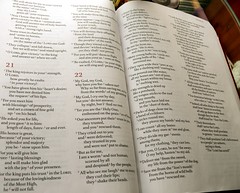
| (My plan doesn't rely on the high tech stuff, but this is my setup.) |
Wednesday, September 25, 2013
My New Bible Reading Plan
Saturday, December 15, 2012
Lost in Translation
![]() |
| Photo by juliaf |
Just yesterday a gunman murdered 20 kindergartners and 6 school staff members in Newtown, Connecticut. I spent yesterday buried in the news, numb with the shock of it all.
Yet today I am working on translating and perfecting my presentation of Christmas Carols in American Sign Language, so I can be ready for church tomorrow. I believe in the true Christmas...one that has nothing to do with trees, elves, white bearded men in red suits, or greed, so I'm dealing with songs that celebrate the incarnation of God Himself.
It's been hard, hard work. Not just because of the struggles that always come with interpreting from one language to another. That's a challenge I actually enjoy. Usually (for example), fitting the convoluted, implied-subject, passive-descriptive imperative form found in the single line, "Veiled in flesh the Godhead see" into ASL grammar within the confines of artistic style and musical speed...well, I would normally relish it. I don't actually know the right grammatical terms for all of it, but I can feel it in my heart, and I love to coax it out and watch it dance on my fingers.
Not this time. Not with a soul that is stunned by the horror of yesterday.
It's so tempting to say that yesterday threw Christmas into the dust, that the bleating of manger-side sheep is drowned out by gunfire, that the cries of labor pains pale next to cries of terror and death, that the message of peace on earth has been disproven. Rendered trite. Annulled.
But, of course, the millennia that have passed since Christ's birth have been full of horrors. If Christ's coming to earth could have been rendered meaningless, it would have happened long before now.
But how can we sing "Peace on Earth, and mercy mild" so soon after Newtown? Can we only sing it wishfully, wistfully, as a prayer for what we hope will happen someday?
How can the truth of these songs not get lost in translation when "the real state of things" is interpreted to us by the hands of madmen?
How can "Peace on Earth" be communicated in a world like ours? The first step is to remember that the song of the angels was not about peace.
It was about the Prince of Peace.
The angels didn't sing a sermon that told people how they ought to live peacefully. They sang an announcement of the One who was, and is, Peace Incarnate.
Incarnation is not the same as interpretation. Some things can't be expressed in language. They have to become flesh and blood.
"The Word became flesh and dwelt among us..." (John 1:14).
Humanity has tried countless ways to interpret the message of peace, but unlike any other communication, this one cannot truly be received without receiving the Messenger.
Oh, it is undeniably true that there are many good, peaceful people who do not know Christ. They are as good as they are by the grace of God, whether they know it or not. If He did not bestow such "common grace," Newtown would happen every day. There is not a single good person on the planet; not one who, if left to his or her own devices, wouldn't become a horror (Isa 53:6, Isa 64:6, Jer 17:9, Mark 10:18, Rom 3:10). So God gives a common form of goodness with the same mercy that makes Him send rain on both the just and the unjust (Matt 5:45). It's a providence largely ignored. It's also a providence that will someday be withdrawn, if I understand 2 Thess 2:7 correctly.
But every human being, even those with a measure of sweetness, kindness, and goodness, needs to be saved from their own sin.
This is the kind of message that the religious elite of Jesus' times could not stand. The kind that made their rage murderous against the most innocent one who ever walked. Think of it... a perfectly innocent adult, telling the religious elite that they needed to repent and turn to Him so they could be saved. They wanted Him dead...and temporarily got their wish.
The world hates that message today, too. Oh, they believe that some people need to be saved, for sure. But they bristle at the thought that they themselves need to be saved from the evil within themselves, and that only Christ can do that. They can't imagine that they could be capable of truly heinous acts, even though history is full of people who, under the right (wrong?) circumstances, did things they never thought themselves capable of.
If they're not a Hitler or a Klebold or a Breivik or a Lanza, they're just fine, thank you.
They want humanity to find a workable interpretation of the message of peace, but without the incarnation of the Prince of Peace in their own hearts.
And peace gets lost in the translation. Because without Christ Himself... trusted, worshiped, indwelling... there is no power for peace with God (the ultimate peace) or for the truest peace with neighbors.
But with Him, everything is possible. And there can be no doubt...if Christ had sat enthroned in the heart of Adam Lanza, conforming him to ever-increasing Christlikeness, including love of neighbor, love of enemies, peace, joy, righteousness...the Newtown Massacre would never have happened. Christ's Spirit inside makes that much difference.
And so I must Sign the songs of incarnation tomorrow with a heart full of hope, and joy, and peace. Because the message has not been annulled, nor can it ever be, as long as The Eternal One lives in people's hearts.
Does He live in your heart by repentant faith?
Isaiah 9:6 (ESV)
For to us a child is born,
to us a son is given;
and the government shall be upon his shoulder,
and his name shall be called
Wonderful Counselor, Mighty God,
Everlasting Father, Prince of Peace.
John 14:27 (ESV)
Peace I leave with you; my peace I give to you. Not as the world gives do I give to you. Let not your hearts be troubled, neither let them be afraid.
1 Thessalonians 5:23-24 (ESV)
Now may the God of peace himself sanctify you completely, and may your whole spirit and soul and body be kept blameless at the coming of our Lord Jesus Christ. He who calls you is faithful; he will surely do it.
Saturday, March 14, 2009
21st-Century Tech and 19th-Century Preachers
Image by almoko via Flickr
At various points throughout the life of this blog, readers have asked questions about how I study the Bible and where I find all of Morrison’s wonderful writings. The answers to those two questions are intertwined, so I’m combining them today.
My main study Bible is the eSword electronic version. It is a free download in its basic form with non-copyrighted Bible versions, but you can also download additional materials such as other translations of the Bible, devotionals, commentaries, Bible dictionaries, maps, and other valuable resources. Some are free, others are not. The daily devotionals have been a very rich resource for me, particularly the Morrison and Spurgeon ones. Yes, that’s right, it’s through eSword that I discovered Morrison. Since it’s not easy to find Morrison’s writings online, it’s worth the download just to get those devotionals.
One of the things I like to do with my eSword is to take copious notes. You can write long notes for any verse and have them available right beside the text. I often copy entire devotional entries into the corresponding verses’ note pages, giving rich insights every time I visit those verses.
There are many other features of this Bible that are quite useful and helpful, but I will stop with simply recommending that you visit the eSword site and investigate it for yourself.
Another very nice downloadable Bible program is simply called “The Word,” and it’s worth checking out as well.
Whenever I’m away from home, I always have a Bible handy, thanks to MyBible 4 from Laridian Publishing. If you use a handheld Palm, Windows, IPod or Blackberry device, you’ll want to check this program out. I wrote earlier about how I use the Scripture Memory program that you can also download from this site, so I won’t go into that again. Laridian also offers devotionals, dictionaries, and commentaries, as well as free and paid translations of the Bible, all for your handheld. I highly recommend this resource.
Another excellent resource is the Christian Classics Ethereal Library. The CCEL is for online use, but it has features you’d often expect only from a downloadable program (such as the ability to highlight text. Your highlights will be remembered whenever you sign in). CCEL offers a wide variety of classic Christian literature, going all the way back to the 1st Century, and moving up to extensive libraries of the greats like Jonathan Edwards, John Owen, John Bunyan, Charles Spurgeon, and more! Definitely an invaluable resource for those of us who could never dream of amassing our own vast printed libraries.
Now it’s your turn. Have you found any “Helpful Tech” that you’d like to share? Or do you have any further comments on the ones discussed above? Please leave your thoughts for us to enjoy.
Friday, December 19, 2008
Tips for Memorizing God's Word
Image by celeste343 via Flickrreciting Psalm 22. It helped me so much to hear that Psalm spoken with meaning and passion, not just read like a dry piece of fiction.After being blessed by that blog, I felt drawn to act on an idea that's been floating around in my mind for a while. I couldn't follow through on it while I was being so deeply moved to write the series on false assurance, the false gospel, etc, that I've been focused on. Maybe that's why the inspiration for that series seems to have dried up for the moment. Perhaps it's time for this entry to be written at last.
Memorize the Word!
We don't know how much longer we'll be free to read or quote from the Bible openly, or even how much longer it will be legal to own the Scriptures at all. Canada, our "democratic" neighbor to the North, has outlawed the preaching of certain portions of Scripture, and has persecuted pastors for preaching truth (hate crimes against homosexuals, you know). So it's not melodramatic to think that our religious freedoms are threatened here.
How does one do that? How do we commit the Word to memory? Once again, I recommend the entry from Challies.com that I referenced above, but of course there are many different methods that help different people. Today I'd like to tell you what has helped me, in the hopes that it may help some of you as well.Memorize the Word!
First, pray for help with memorizing.
Please help me to memorize beyond my ability.
If you have problems with your memory, or doubt that you can memorize, pray for help. Then step out in faith, setting memorization goals that have no restrictions based on what you are able to do. If we are doing what He wants us to do, then our abilities don't matter. His do. And His are limitless.
This is a list of all passages that strike your heart, your conscience, or your mind in any way, but which you aren't able to work on now. Keep this list handy whenever you study the Word, so that you can write down references as you find them. If the list gets too long to be manageable, wonderful! You're treasuring the Word!Second, make a master "Want to Memorize" list
I use the software program "Memorize" from Laridian on my Palm OS device. It's the best memorization software I've found to date. It works in conjunction with the wonderful "My Bible" program, and easily imports verses in whatever version(s) you own. It allows you to keep various lists of verses, and you'll see as we go along just how I use this feature. If you don't use this software, use anything that works for you. For many people, that may just be a spiral notebook.
This is for passages that you're actively memorizing. You don't know them at all yet, or not well enough that you feel confident you could retain them without daily review. I would recommend that you have more than one passage on your "daily" list at a time. That's because sometimes you'll find that a particular passage is harder than others. If you only work on that passage, it will become a cork in the bottleneck of your memorization plan. If you have several passages to work on at any given time, the tough one may stay on your "daily" list for quite a while, but in the meantime you will be mastering easier ones and continuing to accomplish your goals. Currently, my "Daily Review" list has 22 passages on it, for a total of 48 verses. Remember, it has nothing to do with how many I am able to memorize, but simply with how many I feel led to work on now. The Lord provides the ability. Some will require a lot of time, and others will be easier to master. It's all good. Don't try to set a specific number for yourself, unless that sort of thing helps you.Third, make a "Review Daily" list
I think it's important to note here that nothing could be worse than stressing out over your memorization. Don't let Satan get you into that trap! This is a pleasure. A joy. A glorious privilege. Enjoy the Word as you receive it with meekness and the Spirit implants it in your soul (Jas. 1:21). Besides, you'll memorize more easily if you're relaxed with it.
The genius of the "Memorize" program lies in its memory game. When you're ready to work on a passage, you click on "Test." The program gives you a blank screen and asks you to type just the first letter of every word. If you hit the right first letter, the whole word will appear on the screen. If you need help, you hit "Help," and the next word will appear for you. It's simple, but very powerful.
You can do similar things for yourself without software. Copy your passages on a white board or chalkboard and then erase one word at a time, repeating the entire passage and mentally filling in the blanks everywhere you've made an erasure. Or copy the verse on paper and scribble out words one at a time. Use your imagination. It all helps.
When you feel confident that you know a passage well enough to be able to review it only once per week, then move it to a specific day of the week list.
Make Review Lists for Each Day of the Week
After a while, as my "day of the week" lists got longer, I realized that it was important to keep them fairly even in length, so that I wouldn't have one really simple day and another one that gave me a mental tsunami. Of course, if your schedule is such that you logically need some days to be lighter than others, then adjust your lists to meet your needs.
As you move items from your "daily" list into a "day of the week" list, you'll want to re-stock your daily list with new things to memorize. That's where your "Want to Memorize" list will come in handy. I find it very helpful to try to replace outgoing passages with ones of a similar size. So if I just mastered a passage with three verses, I might want to bring on roughly three new verses to take their place.
Oh, and I think it's important to mention here that you might not want the verse references (or "addresses") to be a major issue. I am horrible at remembering addresses, and if I refused to graduate a verse off of my daily list until the address was perfectly mastered, I'd have far less of the Word in my heart right now. I do my best with them, but I don't let them hold me back.
I always feel excited when I get to bring new verses onto my "review daily" list. It's like a mini-Christmas, looking back through my big "Want to Memorize" list and choosing what to work on next. God's Word is so precious!
Currently, each of my "day of the week" lists has between 70 and 76 verses. God is answering prayer and faithfully enabling me to memorize beyond my ability! Praise Him! However, the length of the lists is beginning to be a problem, and there are days when I don't get to do the whole thing. So my next logical step will be the use of "Monthly Review" lists. (I don't mean a list for January and a list for February, etc. That would mean that those passages would be reviewed only once per year!) But I need to establish a list for passages that I know well enough to take off of a "day of the week" list and move to a "once a month" list. And then I need to set aside time in my months to work on that list.
Do you have a plan for memorizing Scripture? Any tips to help others do the same? Please let us know in a comment below, whether by putting the details right in the comment or linking to your own blog. And if you have an encouraging word about how memorization has helped you in your walk with the Lord, please let us know as well.
Tuesday, October 21, 2008
RefTagger
RefTagger recognizes Biblical references ("verse addresses") in the text of the blog, and makes them into links without any effort on the blogger's part. It provides a pop-up window with the text of the verse whenever the mouse is hovered over the reference. Test it out by hovering your mouse over this reference: Is. 46:9-10.
So, for those of you who are readers, the verses will be handy whenever you want to see them.
For those of you who are bloggers, it's a simple matter of going to the RefTagger site, choosing the options you want, and copying some HTML code into your template. It will automatically make links of every reference in the blog, past entries included. And it's free! I anticipate that this will save a great deal of copying and pasting of texts into my entries, and I wanted to share that benefit with you!
Thanks to the "Thoughts on the Way" blog for introducing me to this great feature.


![Reblog this post [with Zemanta]](http://img.zemanta.com/reblog_a.png?x-id=7fc22a6e-2a60-4dc0-9745-736b116adc4d)